Does Decanting Whiskey Do Anything? What Actually Changes
- Does Decanting Whiskey Do Anything? The Short Answer
- Why Whiskey Isn't Wine: The Aeration Difference
- What Decanting Actually Changes
- Should You Decant Whiskey?
- How Long Can Whiskey Stay in a Decanter?
- Decanting vs. the Original Bottle: Quick Comparison
- Caring for a Decanter Between Pours
- The Bottom Line
Does Decanting Whiskey Do Anything? The Short Answer
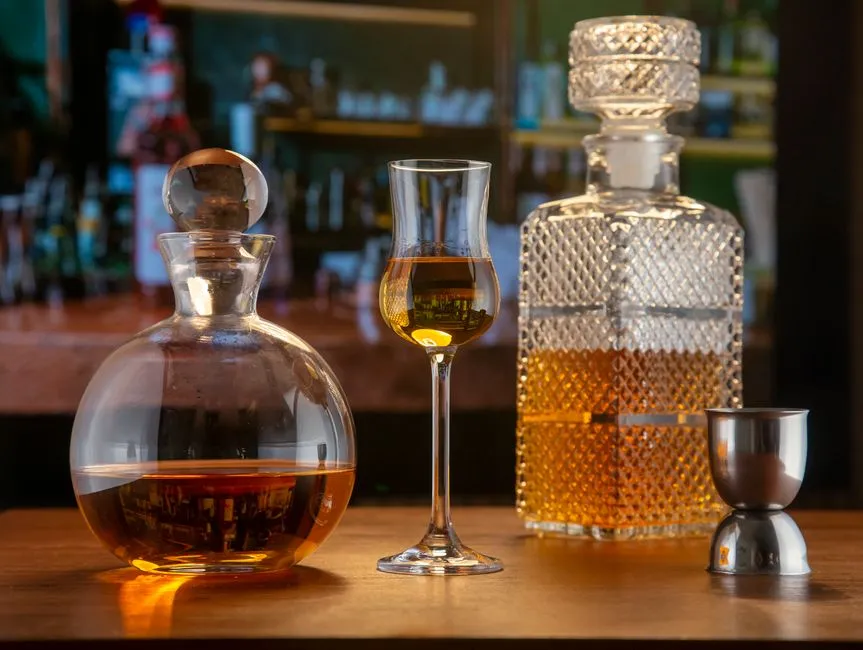
Not much, chemically. Decanting whiskey isn't the same move as decanting a young red wine, and it won't transform a rough pour into a smooth one. What a decanter reliably gives you is presentation, a display-worthy bottle for your bar cart, and — depending on the stopper — a seal that's sometimes tighter than the retail cap it replaced. If you're decanting because you love the ritual or the look of a cut-crystal piece next to your glass, that's reason enough. Just don't expect the whiskey inside to taste meaningfully different twenty minutes later.
Why Whiskey Isn't Wine: The Aeration Difference
The "let it breathe" logic that applies to wine doesn't transfer cleanly to whiskey, for a few concrete reasons.
Wine is typically 12-14% alcohol by volume and carries active tannins and dissolved gases that react with oxygen relatively quickly — that's the whole premise behind letting a young red sit in a wide decanter before serving. Whiskey is a different animal. Most bottled whiskey runs 40% ABV or higher, and that higher proof slows the kind of oxidative reaction that softens wine. There's also far less tannin structure to begin with, since whiskey gets its character from grain, fermentation, and years of barrel contact rather than grape skins.
That barrel contact matters for a second reason: whiskey does almost all of its aging before it's bottled. Bourbon, by law, has to be made from a mash bill that's at least 51% corn and aged in new, charred oak containers — that's where the color and most of the flavor compounds come from. Scotch relies on its own long tradition of malted barley and cask maturation in Scotland. Once either spirit goes into a sealed bottle, that wood-driven aging effectively stops. A decanter can't restart it, and an evening of air exposure isn't a substitute for years in oak.
What Decanting Actually Changes
The Pour Itself Gets a Small Boost
Moving whiskey from bottle to decanter does introduce a burst of oxygen contact and increases the surface area exposed to air, similar to what happens when you swirl a dram in a wide-bowled glass. Many drinkers report that this can round off the sharpest alcohol "heat" on the nose within the first few minutes. It's a real, if modest, effect — and you can get most of the same benefit just by letting a poured glass sit for five or ten minutes, or giving it a gentle swirl, without decanting the whole bottle.
Extended Time in an Open Decanter Can Nudge Things Further
If a decanter's stopper isn't fully airtight, or if you routinely leave it uncapped, whiskey sitting in the vessel for days or weeks will see more oxygen exposure than it would in a sealed bottle. Some drinkers notice a slightly softer edge over that stretch; others notice flatness or a faded aroma as more volatile compounds evaporate. It's not a controlled or guaranteed improvement — it's just slow, ongoing exposure, and it can go either direction depending on the whiskey and the seal.
What It Does Not Do
- It does not replicate barrel aging or add years to an age statement.
- It does not fix a whiskey that's harsh or poorly balanced to begin with — a rough pour stays rough.
- It does not deliver the dramatic transformation wine drinkers associate with decanting; whiskey's higher proof and lack of active tannins mean the effect is far more subtle.
- It does not "improve" whiskey the longer it sits — past a certain point, more air exposure is more likely to dull it than enhance it.
Should You Decant Whiskey?
There's no wrong answer here — it comes down to what you're optimizing for.
| Reasons to decant | Reasons to skip it |
|---|---|
| You want a display-worthy centerpiece for the bar cart | You're happy drinking straight from the original bottle |
| Your current bottle has an unattractive or hard-to-pour design | You go through the bottle quickly enough that transfer isn't worth the effort |
| You like the ritual of pouring from a decanter for guests | The bottle carries a label or provenance you want to keep visible |
| You want a tighter seal than a worn screw cap provides | Your decanter's stopper doesn't seal well, which can do more harm than good |
If your main goal is a better-tasting pour, a few minutes of open-air rest in the glass (or a splash of water) will do more for you than transferring the whole bottle. If your goal is how the bar looks and how the pour feels, decanting earns its keep. Our guide to the best whiskey decanters breaks down what separates a decanter with a genuinely tight seal from one that's mostly decorative.
How Long Can Whiskey Stay in a Decanter?
This depends almost entirely on the stopper, not the whiskey.
With a well-sealed stopper, whiskey can sit in a decanter for months without dramatic change. High proof and a tight seal both work in your favor — there's little oxygen getting in, and the alcohol content resists spoilage in the way perishable foods can't.
With a loose-fitting or ground-glass stopper that doesn't seat well, you're looking at slower, more noticeable drift: evaporation of the more volatile aromatic compounds, gradual oxidation, and in some cases increased susceptibility to any strong odors nearby. A decanter left open on a shelf under direct light compounds this — sunlight and UV exposure can degrade color and flavor over time, decanted or not.
For everyday sipping, decanting is fine. If you're setting a bottle aside for many months or longer, the original bottle with its factory closure is usually the safer long-term container, since it was designed specifically to minimize air contact. Our guide on how to store whiskey covers light, heat, and evaporation in more depth if you're trying to protect a bottle for the long haul rather than just serve from it.
One more honest caveat: if your decanter is lead crystal, it's completely fine for pouring and drinking from — the exposure during a single serving is negligible. But leaded glass can leach small amounts of lead into liquid with prolonged contact, so lead crystal isn't the right choice for whiskey you intend to leave decanted for weeks or months at a time. If long-term decanted storage is the plan, look for lead-free crystal or plain glass instead.
Decanting vs. the Original Bottle: Quick Comparison
| Original bottle | Decanter (good seal) | Decanter (loose seal) | |
|---|---|---|---|
| Flavor impact of storage | Minimal | Minimal to slight over months | Noticeable drift over weeks |
| Seal quality | Depends on closure and remaining cap threads | Can be tighter than a worn cap | Often the weak point |
| Light exposure | Usually low (colored glass, box, cabinet) | Depends on placement | Depends on placement |
| Presentation | Whatever the label offers | High | High |
| Best use case | Long-term storage, half-full bottles | Regular serving, display | Short-term serving only |
Caring for a Decanter Between Pours
However you use it, a decanter that isn't cleaned properly can undo any of the benefits above — residue and film affect both appearance and, eventually, aroma. Rinse with warm water after each use rather than letting whiskey sit and dry inside, and avoid harsh abrasives on cut crystal. Our step-by-step on how to clean a whiskey decanter covers the cloudiness fixes and gentle methods that won't scratch the glass.
The Bottom Line
Decanting whiskey is a presentation choice, not a flavor upgrade. The chemistry that makes wine decanting worthwhile — lower proof, active tannins, ongoing bottle aging — mostly doesn't apply to whiskey, which finishes almost all of its transformation in the barrel before it ever reaches a bottle. Pour whiskey into a decanter because you like how it looks and how it feels to serve, keep the stopper snug if you're leaving it there a while, and skip lead crystal for anything staying decanted long-term. Do that, and there's no real downside — just don't expect the whiskey itself to taste like a different bottle by morning.