How to Build a Whiskey Flight: Order, Pours, Notes
- Build a Flight Around One Question
- Choose the Flight's Question First
- Use Three or Four Whiskeys
- Pick Glasses That Remove a Variable
- Set Up the Table
- Put the Whiskeys in the Right Order
- Taste Each Sample in the Same Sequence
- Add Water as a Controlled Second Pass
- Use a Score Sheet That Captures Evidence
- Run a Blind Flight Without Making It a Trick
- Four Ready-to-Run Flight Plans
- Hosting Without Pushing Consumption
- The Flight Checklist
Build a Flight Around One Question
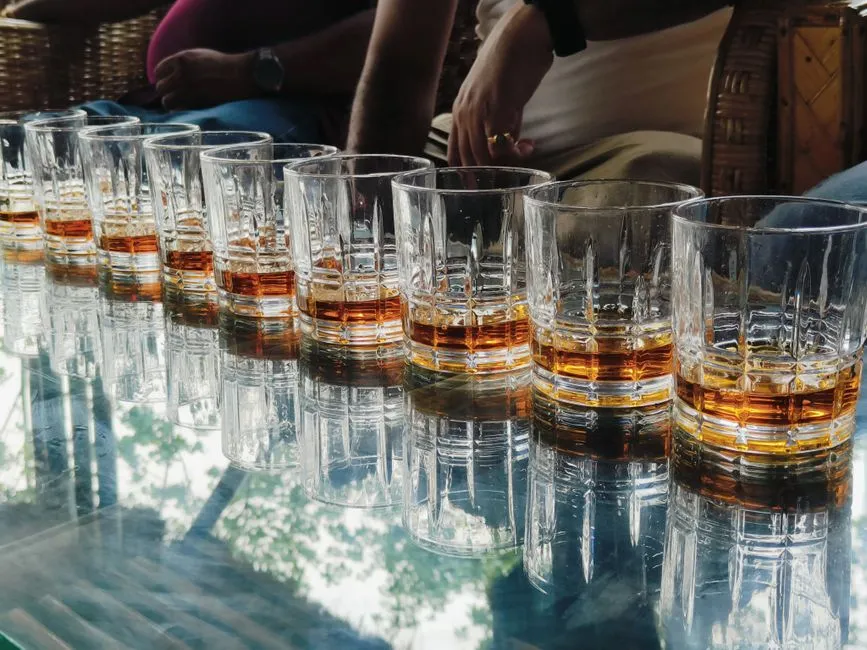
To build a whiskey flight at home, choose three or four bottles that answer one comparison question, pour about 0.5 fluid ounce of each into identical glasses, and taste from lighter and lower-proof to richer, higher-proof, or more smoke-forward. Label the samples, serve water, keep the room free of strong smells, and write notes before discussing the bottles.
The best flight is not a parade of expensive whiskey. It is a controlled comparison. “Three bourbons with different mash bills” answers a question; an assortment of unrelated open bottles obscures the variables.
Choose the Flight's Question First
A useful flight holds several variables steady and changes one. Start with one of these structures:
| Flight idea | Hold steady | Change deliberately | What it reveals |
|---|---|---|---|
| Same style, different proof | Whiskey style | Alcohol strength | Texture, aroma intensity, and heat |
| Same producer, different age or cask | House character | Maturation variable | Oak, fruit, spice, and concentration |
| Same price band, different regions | Budget | Origin and production style | Which profile you prefer at that spend |
| One bottle, different service | Whiskey | Neat, water, and controlled dilution | How the same spirit opens or softens |
| Blind value flight | Broad style and proof range | Brand and price hidden | How much the label shapes expectation |
Avoid a flight so broad that every difference has five possible causes. Comparing a young high-proof rye, a gentle blended Scotch, and a heavily peated single malt may be entertaining, but it is poor experimental design. The smoky bottle is a brass band arriving halfway through a chamber recital; subtlety has left the room.
For a first flight, choose one familiar anchor and two nearby alternatives. The anchor gives everyone a reference point, while the other bottles stretch the comparison without changing the entire vocabulary.
Use Three or Four Whiskeys
Three samples are enough to establish contrast without exhausting attention. Four work well when the sequence has a clear shape: low to high proof, lighter to richer, or entry bottle through cask-finished version. Beyond four, palate fatigue and total alcohol become harder to manage.
Small pours are the right pours. We use about 0.5 fluid ounce per sample as an editorial starting point, not a target anyone needs to finish. Four pours at that size total:
4 × 0.5 = 2 fluid ounces of whiskey
That total matters. The U.S. National Institute on Alcohol Abuse and Alcoholism defines one U.S. standard drink as about 0.6 fluid ounce or 14 grams of pure alcohol; for 40% ABV distilled spirits, that corresponds to 1.5 fluid ounces. A four-sample flight of 0.5-ounce pours totals more liquid than that before higher-proof bottles are considered.
Nobody needs to drain every glass. Provide a dump vessel, encourage tiny sips, and make non-drinking transport the plan before the first pour. A host should be comfortable ending service, offering alcohol-free options, and sending bottles home unopened rather than treating completion as part of the game.
Pick Glasses That Remove a Variable
Use the same glass shape for every sample. A narrow-rim nosing glass concentrates aroma differently from a wide rocks glass; mixing shapes turns glassware into an unplanned variable.
You do not need crystal or a matching engraved set. You need clean, odor-free glasses with enough bowl space to swirl gently and enough separation that nobody grabs sample C while describing sample B. If you are buying specifically for flights, our guide to whiskey tasting sets covers trays, markers, glass shapes, and where a set earns its space.
For four samples and four people, you need 16 glasses if everyone compares side by side:
4 samples × 4 tasters = 16 glasses
If that exceeds the cupboard, run the flight in two rounds of two samples, washing and rinsing thoroughly between rounds. Do not serve one bottle to everyone, collect impressions, then replace it with the next in the same damp glass; residue and timing make the comparison less fair.
Set Up the Table
What each place needs
- Identical tasting glasses, one per simultaneous sample
- A water glass
- A small water dropper, pipette, or teaspoon
- Plain, unsalted crackers or bread if tasters want a neutral reset
- A printed or handwritten score sheet
- A pen
- A dump cup or shared clearly marked vessel
- Sample labels that do not reveal the bottle in a blind flight
Keep food, candles, perfume, smoke, flowers, cleaning sprays, and scented hand products away from the tasting area. Whiskey evaluation depends heavily on aroma, and the room should not contribute its own tasting notes.
Use still room-temperature water without a strong flavor. Sparkling water can reset the mouth between rounds, but bubbles change the sensation if used for dilution in the glass. Serve richer food after formal notes are complete rather than making everyone choose between the finish and a bowl of chili.
Prepare the bottles
Record each bottle's name, stated ABV, style, and any verified label facts on a private answer sheet. Do not repeat marketing copy as production fact. “Finished in port casks” is useful if the label states it; “hand-selected for unparalleled smoothness” is not production evidence.
Cover or remove bottles for blind tasting. Assign simple codes—A, B, C, D—and label both glass and score sheet. If a helper pours out of sight, even the host can taste blind.
Put the Whiskeys in the Right Order
There is no universal order, but one principle works: protect the quieter samples from the louder ones.
Start with the bottle likely to be lightest in aroma, lowest in proof, or least smoke-forward. Move toward fuller body, higher proof, stronger oak, sweeter finishes, and finally pronounced smoke or peat. An assertive sample can make the next delicate whiskey seem thin simply because your senses have recalibrated.
A practical decision order is:
- Lower ABV before higher ABV
- Lighter body before heavier body
- Less oak-driven before more tannic or char-forward
- Unpeated or lightly smoked before heavily smoked
- Standard maturation before strongly flavored cask finishes
These are editorial sequencing rules, not quality rankings. Higher proof is not automatically better, darker is not automatically older, and smoke does not indicate advancement or quality.
For a deliberate A/B test, serving two samples side by side can be more valuable than forcing a linear order. If proof differs sharply, taste the lower-proof sample first, then return to both after measured water has been added.
Taste Each Sample in the Same Sequence
Consistency matters more than theater. Use the same steps for every glass:
- Look. Note color and apparent viscosity without inferring age or quality from either.
- Nose gently. Keep the mouth slightly open and approach the rim gradually rather than taking one deep inhale.
- Take a small first sip. Let it establish proof and texture.
- Take a second considered sip. Note flavor development and balance.
- Wait for the finish. Record what remains and how it changes.
- Add water only after neat notes. Use a repeatable small amount and record it.
- Revisit earlier glasses. Time in the glass can change what you notice.
Our five-step whiskey tasting method goes deeper on nosing, palate, finish, and useful vocabulary. For a flight, the essential addition is discipline: give each sample the same attention and the same opportunity for water.
Do not hold a glass directly beneath the nose and inhale hard, especially with high-proof whiskey. Alcohol vapor can overwhelm aroma and make the experience needlessly harsh. Distance is an adjustment tool.
Add Water as a Controlled Second Pass
Taste every sample neat first. Then add water in a measured way—perhaps a few drops from the same dropper—and record what changed. There is no universally correct number of drops because glass volume, whiskey volume, ABV, and personal preference differ.
For a proof-focused flight, calculate and repeat the water addition rather than free-pouring. If one glass gets three drops and another gets a teaspoon, you are comparing dilution decisions as much as whiskeys.
Ice belongs in a serving-preference session, not a controlled neat comparison. It lowers temperature and adds changing dilution over time. Those effects can be pleasant, but they make it harder to isolate the bottle. If the question is specifically neat versus rocks, then ice is the variable and should be standardized by cube size, starting temperature, and tasting time.
Use a Score Sheet That Captures Evidence
A score sheet should make notes easier, not force false precision. We use five fields:
| Field | Record this | Avoid this |
|---|---|---|
| Nose | Specific aromas and intensity | “Smooth” before tasting |
| Palate | Sweet, grain, fruit, spice, oak, smoke, texture | Copying the bottle's tasting notes |
| Finish | Short/medium/long plus changing flavors | Treating length as automatic quality |
| Balance | Whether alcohol, oak, sweetness, and flavor integrate | One component must always dominate |
| Preference | Would revisit, context, and why | Pretending preference is objective rank |
Write independently before the group talks. The first confident person can anchor everyone else's vocabulary, especially when they announce a specific note with certainty. Compare notes after each taster has committed something to paper.
If numerical scores help your group, define the scale first. A five-point preference scale is easier to use consistently than a 100-point score where nobody can explain the difference between 87 and 88. Always keep written reasons; the number alone teaches very little.
Run a Blind Flight Without Making It a Trick
Blind tasting removes visible brand, price, bottle shape, and label story. It does not remove experience or bias, and it is not an authenticity test.
Choose bottles close enough that the comparison is fair, randomize their order, and keep the answer key private. Tell tasters the broad category if that helps them use relevant language—for example, “three straight bourbons at different proofs”—but do not turn the exercise into a trivia exam.
Reveal in stages:
- Share group notes and preferences.
- Reveal ABV and broad style.
- Let people revise interpretations without changing their original notes.
- Reveal bottle and price last.
The interesting question is not “Who guessed correctly?” It is “Which expectation changed when the label appeared?”
Four Ready-to-Run Flight Plans
Proof ladder
Choose three whiskeys of the same broad style with clearly different stated ABVs. Order low to high. Taste neat, then repeat with measured water. Focus on aroma intensity, texture, flavor concentration, and whether alcohol feels integrated.
One style, three producers
Choose three bottles in the same regulated or clearly described category and similar proof range. This highlights producer character without proof dominating the result. Keep price reasonably close if value is part of the question.
Core bottle and cask finish
Compare a producer's standard expression with one or two clearly labeled finishes. Taste the core bottle first. Ask which flavors seem shared and which appear only in the finish; do not assume every difference comes from the final cask unless the products are otherwise directly comparable.
Blind value flight
Choose three broadly similar bottles at low, middle, and higher prices. Hide price and brand. Rank preference first, then discuss value after the reveal. This tests personal willingness to pay, not a universal market ranking.
Hosting Without Pushing Consumption
Whiskey appreciation is for adults of legal drinking age, and a flight is still alcohol service. Keep pours small, offer water and alcohol-free drinks throughout, serve food after or alongside the less formal portion, and provide a dump cup without comment. Never pressure anyone to finish, keep pace, or explain why they are not drinking.
Arrange designated drivers, taxis, rideshare, public transport, or overnight plans in advance. Do not ask guests to judge whether they are “fine” at the door. People who are pregnant, taking medication, managing a health condition, or concerned about alcohol should follow their clinician's guidance; a tasting guide cannot make that decision for them.
The Flight Checklist
Before guests arrive, confirm:
- One comparison question
- Three or four appropriate bottles
- Bottle ABVs recorded
- Small, measured pours planned
- Identical clean glasses
- Labels and answer key
- Water glasses and droppers
- Plain palate reset food
- Score sheets and pens
- Dump vessel
- Alcohol-free options
- Safe transport plan
The setup should make comparison easy and consumption optional. If everyone leaves knowing why they preferred one whiskey—and nobody had to finish a glass to prove it—the flight did its job.